Is there a scenario where Airbus offers two radically different engine configurations on its next-generation single-aisle aircraft? It is an unlikely development pathway. But let's break down why the question is worth asking.
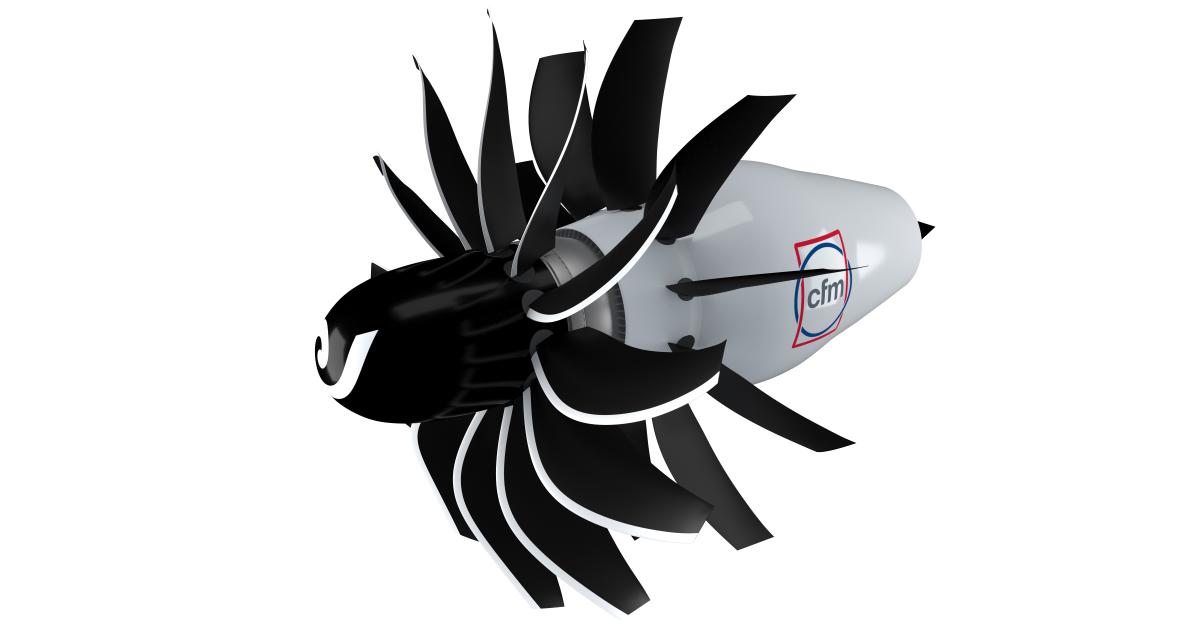
Airbus would almost certainly prefer the successor to the A320neo family to have two engine options, both compatible with a common wing for production-efficiency purposes. But how the European aerospace group could select CFM International's RISE Open Fan concept while offering another, more conventional option for airlines is unclear. That is because no competing enginemakers are actively developing a similar open rotor configuration.
Addressing reporters in Toulouse on October 14, Airbus Commercial Aircraft CEO Lars Wagner told Leeham News and Analysis (LNA) that the scenario where it offers two engine options with two configurations—in order to accommodate both open rotor and ducted engine designs—is "probably not" going to happen.
"The technologies of open rotor and ducted fan are different, and it's going to be a drag and a negative effect if you put it on a similar wing," he said.
It is likely Airbus' preference to offer two engine options as it does with the A320neo family, which is powered by either CFM Leap 1-A turbofans or Pratt & Whitney geared turbofan (GTF) engines.
Airbus insists it is seriously studying the open rotor design advanced by CFM's RISE program, which the companies say could deliver a major efficiency leap. But an open rotor design demands a different wing shape to allow ground clearance for the massive fan.
Because no rival enginemakers are developing an open rotor configuration for single-aisle aircraft, it would be difficult to envision Airbus pairing the RISE Open Fan engine with a more conventional, next-generation ducted turbofan. Doing so would essentially require two wing options—a massively complicated proposition.
Selecting a sole-source engine supplier for the A320neo's successor is not out of the question, however.
Swing Big or Stay Safe?
P&W exclusively provides the GTF engines for the A220, and Rolls Royce does the same for the A350 program. But the airframer would probably prefer to avoid another exclusive relationship for what would become its flagship program in the decades to come. In 2023, Airbus CEO Guillaume Faury specifically said he'd like to introduce two engine options for the proposed A220-500 stretch.
Several years of engine-related operational disruptions—including P&W's years-long GTF recall and CFM Leap's durability issues and long turnaround times—have only strengthened the argument for engine options.
"It is not per se that exclusive is bad," Wagner said. "It's also true, because of the last 20 years, customers are seeing that as 'We need to have the option to choose more.' There are benefits to having an exclusive engine partner, and there are challenges for having a single engine partner. We are trying to optimize between them."
Formerly CEO of MTU Aero Engines, Wagner will majorly influence whether Airbus' next narrowbody engines will be an evolution of conventional turbofans, or a radical new design.
On the other hand, there is a sense that Airbus' next narrowbody jet must be a big enough "game changer" to justify disrupting what has become the most successful program in the history of commercial aerospace. A company that has historically favored incremental aircraft improvements must take a big swing for the follow-up to the A32neo family.
This is where RISE and the Open Fan concept could come in play by dispensing with the nacelle in pursuit of a much-higher bypass ratio.
Wanger said that Airbus and CFM's RISE program are still tracking to launch a flight-test program with an A380 retrofitted with a single open fan engine in 2029. How the engine performs will play a major role in determining Airbus' direction for its next single-aisle propulsion package.
"We are thinking about this technology," he said. "We want to test fly it, and we need to make sure that this is generating the benefits that we currently anticipate."
Boeing, by contrast, has been less enthusiastic about the Open Fan design, though Boeing Commercial Airplanes CEO Stephanie Pope told LNA earlier this year that the U.S. airframer had not definitively ruled out such an engine architecture for its next clean-sheet aircraft.
Time for Testing?
Airbus has previously targeted 2030 for launching the next narrowbody program, aiming for service entry late in the 2030s. Some industry observers believe the next single-aisle jets will enter service even later, perhaps in the early 2040s.
With Open Fan flight-testing set for 2029 and a program launch expected the following year, whether there will be enough time to assess the open rotor's potential is a reasonable question. Wagner said that Airbus "has other means today in simulating it and bringing it to the test bench" and is already in data-collection mode.
"Everything is lined up for the notional timeline we have given," he reiterated, later adding: "It's going to be a game-changing aircraft. That means it needs to have [new] technologies and innovation" to be "competitive in 30, 40, 50 years."
If the open rotor concept truly delivers a step-change in efficiency, the required work-arounds—including a new wing configuration and a reinforced fuselage to protect passengers from blade-outs—become acceptable. LNA believes anything short of a 15% efficiency gain would likely be a non-starter.
Airbus is not putting all its chips on the Open Fan, with Wagner acknowledging that it is also exploring the next generation of ducted turbofans. And while P&W has publicly derided the Open Fan concept and signaled its belief that next-generation aircraft will be powered by turbofans, the U.S. enginemaker has its own history of developing unducted fans. Evidence suggests those efforts are likely ongoing in the background.
This story was first published by Leeham News and Analysis, which is part of the AIN Media Group. Subscribe here for exclusive coverage of the commercial aerospace sector.
More In Engines