Hydrogen aviation companies are turning to defense contracts, data center power, and airport ground equipment for near-term revenue while certified hydrogen aircraft slip further into the future, speakers said November 4 at the HySky Society’s Flying Hy 2026 symposium. The virtual event drew start-up executives and engineers as well as regulators and researchers to discuss the technology, certification, and funding hurdles facing hydrogen-powered flight.
This shift toward other markets follows a bruising stretch for the sector. Airbus acknowledged in February 2025 that its ZeroE hydrogen airliner would miss its 2035 service-entry target, and it has not committed to a date since. Universal Hydrogen ran out of cash and closed in 2024, and Australian start-up Stralis Aircraft abandoned its hydrogen propulsion plans in August 2026 after failing to secure funding.
Money is scarce for start-ups building complete hydrogen aircraft in part because of how the U.S. government funds research, according to Eternium Aerospace founder and CEO Jared Semik, whose Novato, California-based company is developing a hydrogen-electric, blended-wing-body aircraft for long-range cargo flights. The Department of Energy, NASA, and the FAA each work in their own silo, he said during the symposium, and no agency takes responsibility for a complete hydrogen aircraft, so federal money goes to individual components instead.
ZeroAvia, which develops hydrogen-electric powertrains for regional aircraft, has also downsized over the past year. The UK-based company recently closed its R&D facility in Everett, Washington, cut its workforce by about half, and reshuffled its leadership. Christine Ourmières-Widener, who succeeded Val Miftakhov as CEO earlier this year, said the company’s board directed management to reduce risk in its plans and bring in revenue sooner. “We did have the mission from the board…to think about strategy and de-risking the roadmap and making sure we should become revenue positive as soon as possible,” she said in her presentation on ZeroAvia’s roadmap.
Defense Brings Demand
For ZeroAvia, defense has become an unexpected source of demand, according to Ourmières-Widener. Small fuel cell-powered drones are already flying in Ukraine, she noted, and ZeroAvia aims to scale the technology up for larger military aircraft, either as the main powertrain or as an extra power source for onboard systems. Fuel cells run at “a much lower temperature and much lower noise,” she said, which gives defense customers “some capabilities that we never had in mind when we started the company.” “We have now a strong demand and expectation from defense,” she added.
ZeroAvia announced a defense collaboration with Marshall Aerospace in July. Its 200-kilowatt fuel cell power generation system should reach technology readiness level 6—meaning a prototype demonstrated in realistic operating conditions—in 2027, the same year first deliveries are due to begin, Ourmières-Widener said. Series production would follow at the end of 2029. A high-temperature fuel cell suited to single-aisle and widebody airliners will not arrive until after 2030, she said.
Los Angeles-based Hydroplane has leaned on military customers since a U.S. Air Force Agility Prime contract helped launch the company during the Covid-19 pandemic. “We’ve been largely funded by the military,” founder and CEO Anita Sengupta, a former NASA engineer, told the symposium, citing contracts with the Air Force, Army, and Marine Corps. Her company, which develops hydrogen fuel cell engines for airplanes and helicopters, expects to turn a profit this year for the first time. “We actually operate on revenue,” she said. “We live within our means.”
Chris McWhinney, founder and CEO of Dayton, Ohio-based Millennium Reign Energy, told attendees that a hydrogen drone flight the company conducted at a NATO conference in Portugal in 2021 drew interest from air forces and navies around the world. The drone stayed aloft for four hours, while the same airframe flew for 45 minutes on batteries the day before.
Military drones are also a target market for FC Renew, whose founder and CEO, Philip Stuckey, used his Flying Hy presentation to pitch a longer-lasting fuel cell catalyst, the material that drives the reaction turning hydrogen into electricity. The Knoxville, Tennessee-based start-up counts the U.S. Army among its backers. Fuel cells lose power as they age, so designers install larger cells than a drone needs at first to make sure it still has enough power late in its service life, he explained. A catalyst that degrades more slowly lets the drone carry a smaller and lighter fuel cell. FC Renew’s catalyst lasted 28,000 hours in accelerated stress tests versus 4,000 to 10,000 hours for conventional catalysts, Stuckey said.
Ground Power Widens the Market
Hydrogen companies need customers beyond aviation to build a viable business, Sengupta argued. “With the growth of data centers, power consumption from that sector is huge,” she said. “So if you can come up with ways to couple to that market, then it makes [hydrogen power generation] a more viable business opportunity. So you don’t just have to be limited to the small sliver, which is the aviation sector.”
Millennium Reign Energy builds on-site hydrogen production and fueling stations for everything from drones and eVTOL aircraft to cars and trucks. It wants to serve power and transportation customers from the same hydrogen supply. Last December in southern Ohio, the company powered “the first ever data center that ran on hydrogen,” McWhinney said. Now it is working with an unnamed developer on 1- to 10-megawatt data centers that make their own renewable power and store the excess as hydrogen. McWhinney envisions adding a vertiport and car fueling station at each site to create “lily pads” that hydrogen aircraft and vehicles could hop between “all the way across the country.”
Hydroplane, for its part, offers a ground-based version of its aircraft fuel cell system that could replace the polluting diesel generators often used for airport ground power and disaster relief, Sengupta said. The FAA’s December 2024 hydrogen certification roadmap likewise called non-propulsive uses such as auxiliary and emergency power “the most mature concept for commercial aviation” and ranked hydrogen-burning turbine engines as the least mature.
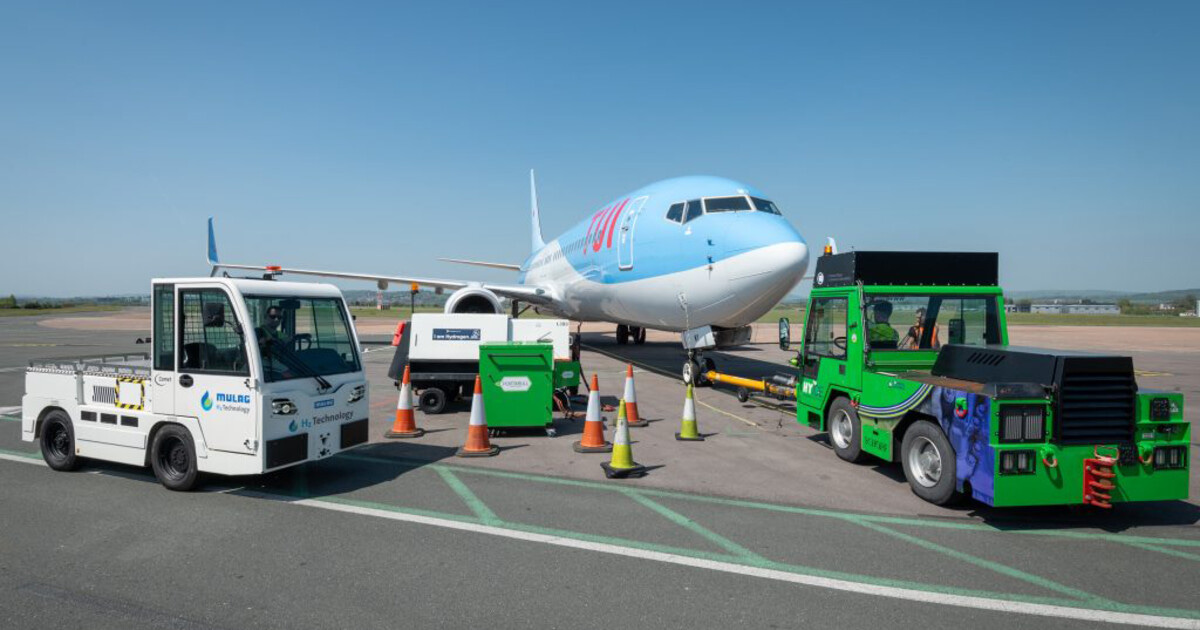
Hydrogen ground equipment has already been tested in the UK. A Civil Aviation Authority program supported a zero-emission aircraft turnaround at Exeter Airport (EGTE) with TUI, Cranfield University and Boeing, said Helen Leadbetter, the regulator’s zero-emissions flight lead, at Flying Hy. In the trial, three pieces of ground support equipment ran on a fuel cell, a hydrogen combustion engine and a hybrid system, she said.
Fuel Prices Boost Hydrogen’s Appeal
Speaking at the symposium, Eloa Guillotin, CEO of Toulouse, France-based Beyond Aero, pointed to “the volatility in the price of jet fuel and kerosene” and “a sovereignty aspect” to producing hydrogen locally, which lets operators “rely less on other countries.” Beyond Aero remains focused on certifying a hydrogen-electric business jet in the early 2030s.
Serge Markoff, founder and CEO of Sea Cheetah, said during his Flying Hy talk that diesel prices for aviation and marine users have spiked 80% to 90%, and interest in his company has followed.
Miami-based Sea Cheetah, with offices in Dubai and Brisbane, Australia, is developing a hydrogen-powered wing-in-ground-effect vessel that falls under maritime rules rather than aviation regulations. It needs “no runway and no airspace slot,” Markoff said. One of its customers is an airline that wants to carry its passengers onward to a resort, he added.
Big OEMs Play the Long Game
Ourmières-Widener noted that “the significant industrial players have been confirming their ambition in hydrogen,” pointing to Airbus, GE Aerospace, and Safran. Airbus and MTU Aero Engines formed a hydrogen fuel cell propulsion venture in July.
GKN Aerospace is designing the electrical and cryogenic distribution system for a liquid-hydrogen fuel cell airliner in the ZeroE class, said Mark Husband, who leads the electrical power networks team at the company’s technology center in Bristol, UK. Programs running through 2029 will scale its technology from a 19-seat demonstrator to a 96-seat aircraft, he said in his presentation, describing what would be “the first CS-25 all-electric aircraft with no conventional aircraft as a baseline.”
Rolls-Royce worked with easyJet for four years toward a hydrogen-burning engine for narrowbody airliners, concluding the partnership this year with a test run of a modified Pearl 15 engine on 100% hydrogen at NASA’s Stennis Space Center in Mississippi, and it has since paced its hydrogen work to the market’s maturity. Rob Watson, the company’s president of civil aerospace, said at a July 2 media briefing that delivering hydrogen at industrial scale is “not our area of focus.”
Airbus and CFM International agreed in 2022 to fly a hydrogen-fueled GE Passport engine on an A380 by the end of 2026, but Airbus canceled that test flight as part of the broader scaling back of its ZeroE program in early 2025.
The FAA’s roadmap says existing airworthiness standards “did not envision fuel cells, nor the use of hydrogen to fuel an aircraft engine,” and the agency does not plan to publish formal hydrogen regulations until the 2028-to-2032 period. Until then, applicants such as ZeroAvia must work through special conditions.
Hydrogen and electric propulsion should deliver 13% of the emissions reductions aviation needs to reach net zero by 2050, according to the International Air Transport Association (IATA). In an October analysis, the airline trade group said hydrogen aviation “currently faces broader infrastructure, operational, and energy challenges” and that scaling it up will require “substantial policy and investment support.”
Ourmières-Widener framed ZeroAvia’s near-term products as a bridge to that future. It is “very important to have an early proof, early application of this technology,” she said, “to make sure that we have even more supporters in the world who believe in hydrogen electric in aviation.”
More In Fuel