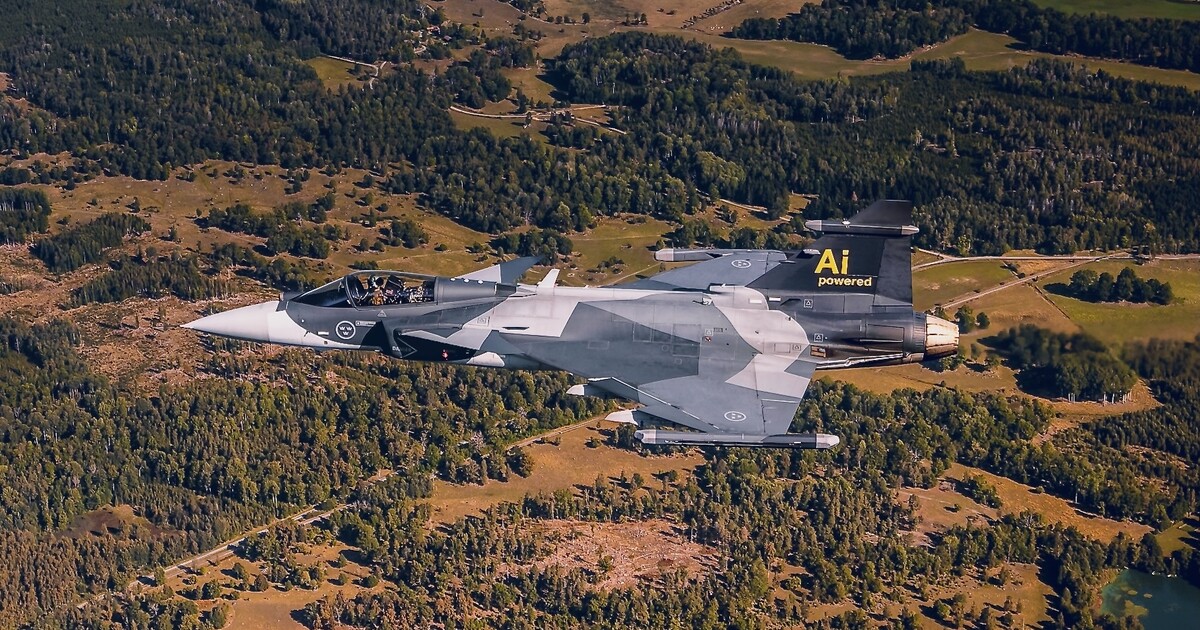
Saab Aeronautics has revealed that it has been developing and training its own artificial intelligence (AI) agents to perform and aid air combat tasks. Moreover, the Swedish defense group has been testing them in the air aboard the Gripen E fighter for around two years. Trials have involved agents performing a range of typical air combat tasks, such as area assessment and denial, and battle damage assessment.
Now they are ready for operational deployment, Peter Nilsson, Saab's head of advanced programs told journalists at a briefing on October 30. The only hold-up is the ability of the customer—in this case Sweden's FMV (defense materiel administration) and the air force—to absorb them into real-world operations.
Work is progressing at pace to achieve this, and Nilsson suggested that this could take just “months, or single digits of years.” The speed at which such agents can be deployed is accelerated by the Gripen E’s open architecture, which segregates mission software from flight-critical functions.
Saab has also been working with other agent developers, as it sees the ability to integrate third-party agents alongside its own as a key aspect for future AI development. On May 28 last year a Gripen E trials aircraft flew for the first time with the Centaur agent from Helsing installed. It successfully demonstrated the ability to perform beyond visual range air combat in a series of engagements under Project Beyond. The two companies continue to work on developing Centaur.
Developing AI technology starts with clearly defining the decision, behavior or outcome that it is being developed to improve. That requires deep military domain knowledge, something that is abundant within Saab’s ranks, as well as knowledge and understanding of computer and AI technology. Nilsson’s department has around 40 percent of its staff at PhD level, and works closely with government and academic institutions.
Due to the nature of training and testing AI agents to a deployable level, which involves conducting numerous repeated loops, the need for computational power is huge. Until now, work has been largely conducted using CPU-based architecture. While this has offered sufficient power to train agents to a deployable state, it is still too slow for the rapid training and fielding of agents that is required for continuous improvement in their behaviors.
Boosting AI Power
That has now changed with the recent implementation of the Sferical AI facility in Linköping. Part-owned by Saab, Ericsson and AstraZeneca, the facility is a Swedish sovereign asset that allows users to run agent training and testing at huge scale, negating the need to rent, time on other facilities at great cost.
Based on U.S. tech giant Nvidia's DGX SuperPOD architecture, Sferical runs on 1,152 Nvidia Grace Blackwell GB300 GPUs. The computational power available allows Saab to run a one-hour flight test a billion times in the same period, compared with 1,200 times in a CPU-based environment. This level of performance transforms AI training from a linear, time-restrained process into a continuous industrialized capability.
Saab’s air combat agent training is now collected under the banner of the AI Fighter Pilot Academy (AIFPA), which offers the capability to train Reinforcement Learning agents at unprecedented scale, and also to develop large language models. Both approaches can be integrated into hybrid agents that simultaneously give excellent results in both single-task operations and the response to wider-area developments.
AIFPA agents are destined for both crewed and uncrewed assets, and to facilitate the integration of both into combat operations. Agents developed for Gripen E will also be adapted for autonomous collaborative platforms, and vice versa, and even for implementation in other force assets such as the GlobalEye airborne early warning aircraft.
Whereas early AI applications were aimed at single tasks, the arrival of much greater computational power has driven AI applications to larger scales and to increasingly larger forces. Now AI is looking forward to application in multi-domain World Models. Saab believes that it is well-placed to become a leader in this field owing to its significant experience in air, sea, land, underwater and space domains, and also its access to the kind of computational power required to build world models.
With an eye on this goal, as well as driving greater synergy in company-wide AI development, the company has recently established a new business unit, known as Common Technology, which can pool AI development efforts from across the company’s other business units.
In this article
More In Aircraft