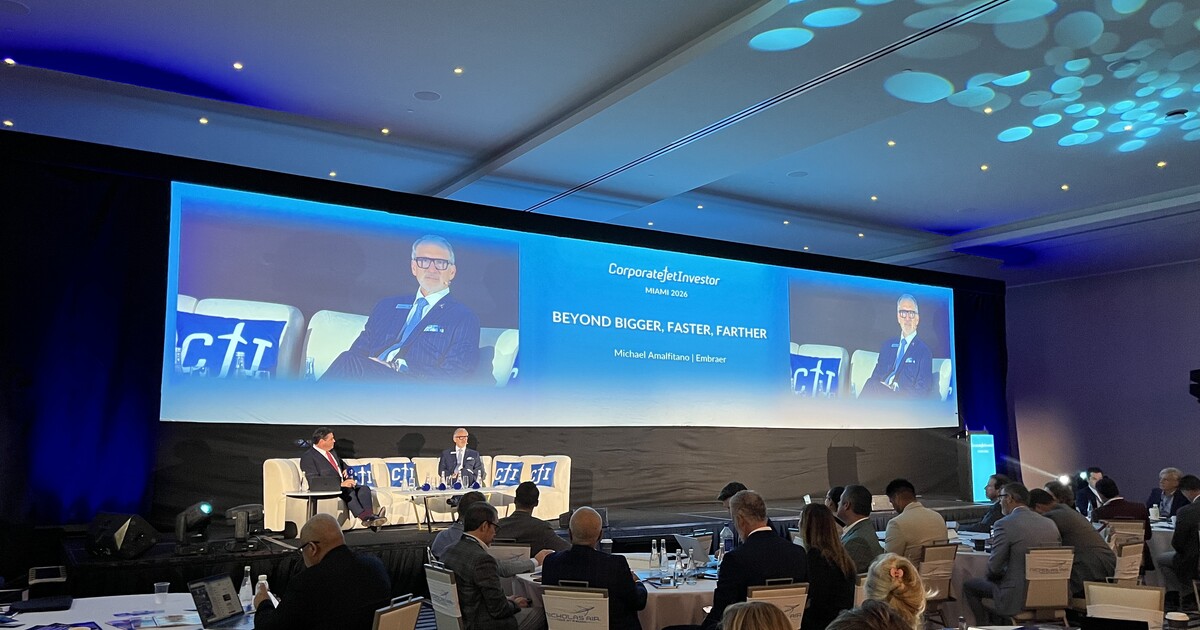
Embraer Executive Jets president and CEO Michael Amalfitano said business aviation has been misdiagnosing its parts problem. “It’s not supply chain,” he said Tuesday during the “Beyond Bigger, Faster, Farther” session at Corporate Jet Investor Miami. “It’s about capacity, integrity, and cadence.”
The core problem, he said, is single sourcing. He pointed to windshields, citing PPG as a main manufacturer: defense customers get first call (“there’s a war going on”), and Airbus and Boeing are next in line.
That pressure weighs on Embraer’s record backlog. “You cannot sacrifice the current fleet operators for building and selling a new airplane,” Amalfitano said, adding that the company also can’t shortchange its order book for a large fractional provider. “You’ve got to do them both, and you’ve got to do them both well.”
Operators need OEMs to stay healthy, he argued, because their investment funds the infrastructure, certification, and clean-sheet designs everyone relies on.
He called wealth creation “the biggest growth driver to business jets and general aviation,” saying it will “outpace any of the headwinds” earlier panelists described. He cited last year’s UBS wealth report as showing 11% growth in the Americas, the highest of any region, and pointed to a coming wealth transfer he called the most significant “in decades.”
Fractional and jet card programs, which he said have “democratized” access, are the fastest-growing segment, and their customers don’t care about ownership. For them, he said, the aircraft has to do only one thing: get them where they’re going with as little friction as possible.
That drives what Amalfitano calls business aviation as a service. “You can’t just sell the airplane,” he said. Customers want “a full view of the future of their operations, not just the purchase.” He sees room for digital tools, including AI, across Embraer’s parts, MRO, and service-center network, though regulation is the hard part.
Certification is also where Embraer holds an edge. It certifies first with Brazil’s agency, ANAC, where “no one’s in front of us,” then gains FAA and EASA approval through bilateral agreements. Going to the FAA first would mean “a long line” that is “much more painful, much more time-consuming, much more expensive,” he said. He highlighted three launches this year—the Praetor 500E and 600E, and Phenom 300EV
The Praetor 600E’s Smart Window, “six to seven years in the making,” uses a form-fitted, large touchscreen monitor to turn a two-zone cabin into three usable zones for movies or Zoom calls over Starlink. “Why do you have to look out a real window to see what you can see?” he asked.
Executive jets account for about 30% of Embraer’s revenue, profit, and cash, making the unit “by far the growth engine for the company,” Amalfitano said. Those figures exclude services, which Embraer reports separately, unlike its peers. “My returns only include airplanes,” he said. Training, he added, is a major driver of service margins.
In this article
More In Aircraft