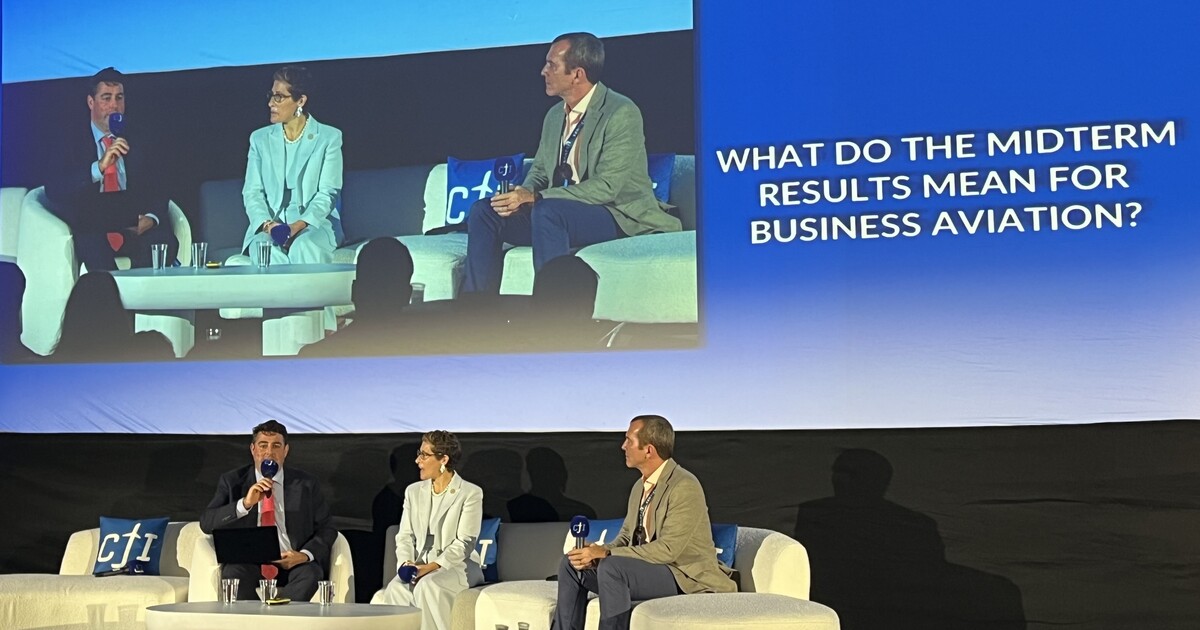
Business aviation could face mounting political pressure in a newly divided Washington, NBAA’s top lobbyist warned at the recent Corporate Jet Investor (CJI) Miami conference, as the industry also enters a fresh fight over funding to modernize the U.S. air traffic control system.
“There’s a rising bipartisan populism that puts our industry in the crosshairs,” NBAA senior v-p of government affairs Kristie Greco Johnson said during a panel examining what this month’s midterm elections mean for the industry. She noted that pressure intensifies whenever resources become scarce, “whether that’s a fuel crisis, or a government shutdown and an FAA-mandated reduction in operations, or a nationwide groundstop—there will be calls to ground business aviation in those events.”
Moderated by CJI’s Alasdair Whyte, the session came days after the FAA halted departures nationwide following a telecommunications outage that affected its Air Route Traffic Control Centers (ARTCCs). Johnson and fellow panelist Andy Fishburn, v-p of public policy at ICSC, said an incoming Democratic House majority sets up two years in which major legislation will be difficult to advance.
Johnson said NBAA’s response is to close a knowledge gap among policymakers that the association’s own research identified. The industry, she said, must “fill the gap in knowledge with policymakers about business aviation not being a luxury but an essential American industry.”
She pointed to business aviation’s 1.3 million jobs and $340 billion in economic impact, as well as its role in allowing large companies to keep headquarters in small and midsize communities. She also cited humanitarian flights that carry cancer patients and veterans to treatment and the industry’s goal of net-zero emissions by 2050, calling such commitments “issues that are of importance to Democratic policymakers.”
NBAA is carrying that message through its Climbing Fast campaign, which Johnson said has helped the association “win some key fights in the last couple of years.”
Groundstop
Asked whether the November 13 groundstop would make it easier or harder to secure ATC funding, Johnson replied, “The test will happen this week.” She described the outage as “a prime example of the legacy system creating challenges in the system” and “a proof point to why we need air traffic control modernization.”
Transportation Secretary Sean Duffy raised the administration’s funding request to $50 billion on the evening of the groundstop, hours after the White House and DOT had renewed a call for an additional $30.1 billion. On November 17, the DOT formally asked Congress for $50.1 billion, including $10.1 billion for ATC technology, $10 billion to build five new consolidated ARTCCs, $10 billion for up to 140 control towers, and $20 billion for airport improvements. The request comes on top of the $12.5 billion Congress approved for ATC modernization in July 2025.
Johnson said Democrats are challenging the request by arguing that the administration has not yet spent the money it already has. She countered that existing funds are committed to work streams already under way that “won’t be finished until the end of 2028 or slightly beyond,” while the new money would cover additional projects to improve efficiency and safety, including rebuilt towers and completion of the telecommunications upgrade.
She called on lawmakers to move past the partisan criticism that followed the outage, saying “the pathway to additional funding is really on bipartisan grounds,” though the subject’s technical complexity makes that case harder to make. Johnson also highlighted the Modern Skies Coalition, which she described as “an historic coalition of more than 60 organizations that have set aside the air traffic control privatization fights in the past to support building a brand-new air traffic control system.”
“I’m hopeful that we’ll be able to secure some significant portion of money to keep that project going,” she said.
Rebuilding
Fishburn, who noted that his views were his own and not those of his employer, said his experience handling appropriations at the Treasury Department showed that federal budgeting has been dysfunctional under both parties. He described a recurring pattern in which Congress approved a 2% federal pay raise but funded only half of it, leaving agencies further behind each year, a practice he called “20 years of compounding of bad budgeting for the government.”
For a program the size of ATC modernization, he said, “the appropriations process is so fundamentally broken.” Fishburn added that filling Senate-confirmed positions will be difficult over the next two years and that recruiting is challenging, describing the federal workforce as “disenfranchised—that’s probably a polite term.” He named appropriations and “the day-to-day management of the federal government” as his two biggest concerns.
Johnson agreed. “Just running the FAA is oftentimes building the plane while you’re flying, and air traffic control modernization is that in an exponential sense,” she said. The effort requires strong agency leadership to keep the legacy system handling 45,000 to 50,000 daily flights while new infrastructure and technology are brought online, she explained.
Responding to an audience question about whether the groundstop would revive efforts to privatize ATC, Johnson noted that the Wall Street Journal had already cited the outage in calling for privatization. NBAA will challenge such calls, she said, arguing that the system is improving and that “this administration has made more progress in the last few years than we have in the last few decades on modernization.
“Frankly, we’ve seen other systems in other countries that are privatized face similar problems, so privatization is not a panacea,” Johnson said. She added that privatization does not resolve workforce shortages, problems with technology rollouts, or safety concerns.
Outlook for New Congress
Johnson said voters sent a message that they wanted change and a check on the president, but she expects positioning ahead of the 2028 elections to limit legislative output. “With a divided government, we may not see the level of progress or product from the Congress that we did in the last two years,” she said. She added that House Democrats are debating whether to prioritize investigations and oversight or legislation focused on affordability.
Fishburn predicted that voters hoping for bipartisanship will be “sorely disappointed.” He expects the House to impeach the president, possibly as early as March or April, but not the Senate to remove him. He also forecast that “there will be government shutdowns of varying lengths, and that might come as early as next month.”
Johnson said there is still room for agreement on “smaller parochial issues” that NBAA works on, such as pilot mental health and modernization of the FAA’s aeromedical office.
Asked how the industry can engage policymakers not swayed by facts, Johnson said she had expected the administration’s unpredictability to complicate NBAA’s advocacy. “It turns out the fundamentals still work: building coalitions, direct in-person meetings, making the case about your needs in the industry has helped win us the day,” she said, pointing to tariffs unlike any the industry has seen in 45 years and the January 2025 midair collision at Ronald Reagan Washington National Airport (KDCA) as challenges the industry navigated by uniting “in ways that we have never been united in the past.”
More In Regulations and Government