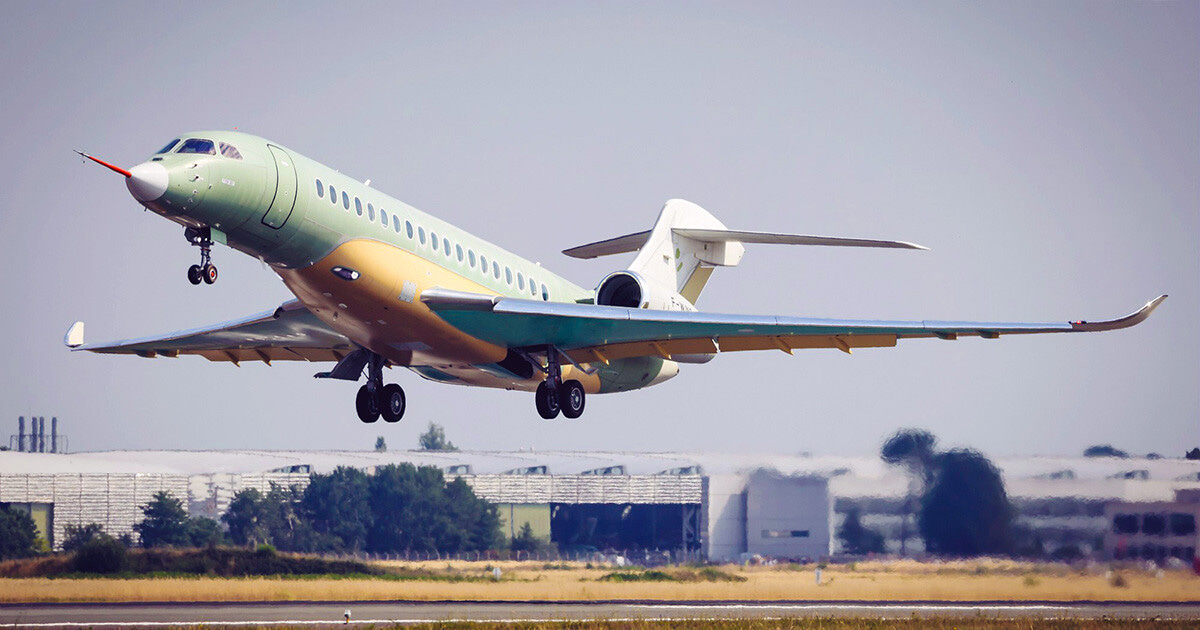
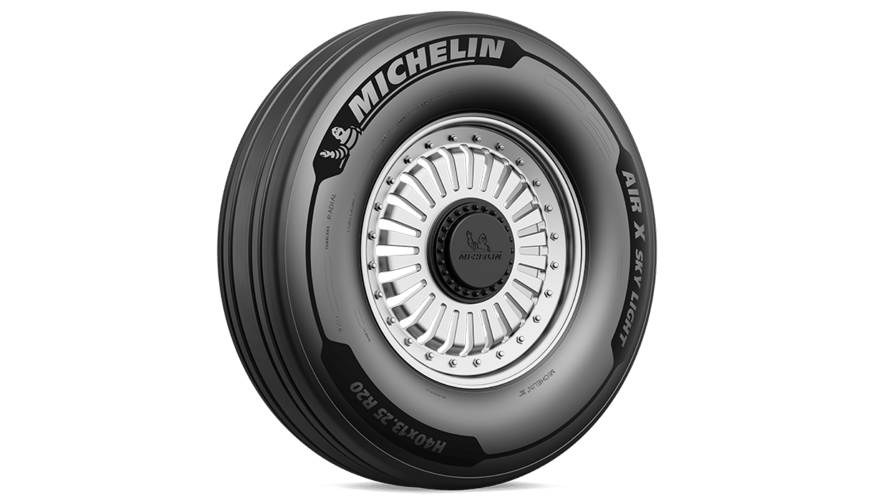
When French airframer Dassault Aviation’s Falcon 10X lifted off from Bordeaux-Mérignac Airport (LFBD) for its first flight on June 19, it rode on tires that Michelin says weigh 10% to 20% less than their predecessors and last 10% to 20% longer. Clermont-Ferrand, France-based Michelin began developing the tire, called Air X Sky Light, with Dassault in 2019. So far, the tire comes in only one size, built for the ultra-long-range business jet.
Gains of up to 20% sound modest, but they are hard-won. Every ounce removed has to come out of a part that works under severe loads, speeds, and temperatures, and the lighter tire still has to pass the same certification tests as its heavier predecessors.
An aircraft tire is a pressure vessel, a suspension component, and a heat sink all at once: it holds high-pressure gas, cushions every touchdown, and absorbs brake heat. It must do all of this hundreds of times before replacement. Each of those jobs limits how much material engineers can remove, and regulators test for every one of them.
Built for Extremes
Certification rules show how punishing an aircraft tire’s working life is. Under the FAA’s technical standard order for aircraft tires, TSO-C62e, manufacturers must show that tire materials survive 24 hours at minus 40 deg F and another 24 hours at 160 degrees without degrading.
The rubber must also tolerate an hour against a wheel rim heated to at least 300 degrees, the kind of heat that brakes push into the wheel. A finished tire must also withstand four times its rated inflation pressure for three seconds without bursting.
Heat is a constant adversary. Every landing, taxi, and braking event puts energy into the casing, and that energy has to go somewhere. How well a tire copes with it depends partly on how that casing is built.
The modern era of casing design began in 1981, when Michelin introduced the world’s first radial aircraft tire on a Dassault Mirage III fighter. Forty-five years later, the same two companies are refining the idea on a business jet.
What set the radial apart from earlier bias-ply tires was the direction of its cords. Every aircraft tire is anchored to its wheel by two beads, or wire-reinforced rubber hoops that also seal it against the rim. Between them, layers of rubber-coated cord called plies form the casing, topped by the tread, the grooved rubber that meets the runway. A bias tire’s plies run diagonally from bead to bead, crisscrossing at alternating angles. A radial’s plies run straight across, at roughly 90 degrees to the direction of travel, held in shape by a belt that barely stretches.
Michelin says its Air X radials typically weigh 20% to 30% less than comparable bias tires and run cooler. It also credits what it calls Near Zero Growth technology with up to 50% better resistance to foreign object damage than bias tires. That technology relies on a high-strength composite cord that stretches less than nylon, so a tire needs fewer plies to reach the same strength.
Air X Sky Light changes three zones at once, according to Michelin: a reworked tread area with an optimized footprint that leaves more rubber available to wear, a redesigned bead that the company credits with making the tire much lighter, and a reworked sidewall. Michelin says hybrid cords and fabrics in the bead and sidewall are both stronger and lighter than earlier ones.
Competitors are attacking the same problem from other angles. Goodyear’s Flight Radial pairs a lightweight aluminum core bead with cord that combines Kevlar and nylon. Bridgestone developed its Revolutionarily Reinforced Radial after the July 2000 Concorde crash. That design prioritizes casing integrity and limits the scatter of fragments when a tire fails. On Concorde, tire fragments ruptured a wing fuel tank, starting a fatal fire.
Why Lighter Is Harder
Because the switch from bias to radial banked a 20% to 30% weight cut decades ago, today’s gains come from much thinner margins. Durability, measured in landings per tread, matters as much as weight. A lighter casing saves fuel on every flight, but it also has to last. Operators often get several treads out of one casing through retreading: when the tread wears out, a repair station inspects the casing, buffs off the old rubber, and bonds on a fresh tread.
Whether a lighter tire can last is tested long before it reaches an airplane. TSO-C62e requires a single test tire to survive 61 cycles on a dynamometer, a large spinning flywheel: 50 simulated takeoffs, eight taxi runs at rated load, two more at 1.2 times rated load, and one takeoff that starts at 1.5 times rated load.
Each simulated takeoff covers 6,500 to 11,500 feet depending on the tire’s speed rating, and each taxi run covers 25,000 to 35,000 feet, or roughly 5 to 7 miles. The tire never gets a cool start: most takeoff cycles must begin with the tire at 105 degrees or hotter, and most taxi runs at 120 degrees. After all 61 cycles, the tire must still hold its pressure within 10% for 24 hours.
Retreads run the same sequence under the FAA’s retread guidance, AC 145-4A, though a retreaded tire needs only to survive three times its rated pressure in a burst test, compared with four times for one fresh from the factory.
The TSO-C62e test sequence has remained largely unchanged for decades. Its core structure dates to at least 1990, and the 2006 revision added only minor refinements. The European Union Aviation Safety Agency adopts the FAA standard by reference, so tires face the same test on both sides of the Atlantic.
Every tire model must pass all 61 cycles to earn approval, and so must any change to an approved design that could affect its performance, such as a different cord material or tread compound. Once a change has passed in five representative sizes, though, a manufacturer can extend it to its other sizes by similarity rather than retesting each one. Michelin says developing and certifying a tire size takes two to three years, which helps explain why a technology unveiled at the 2023 Paris Air Show is only now flying, on one airplane.
Where Tires Fail
A tire that passes every lab test still has to survive the way it’s maintained, and the FAA’s guidance points first at pressure. The agency’s tire maintenance circular, AC 20-97B, calls pressure upkeep “the single most effective task” in preventive tire maintenance. SAFO 11001, a 2011 FAA safety alert for operators on tire inflation, illustrates the stakes with two fatal accidents.
In 1991, a DC-8 departing King Abdulaziz International Airport (OEJN) in Jeddah, Saudi Arabia, crashed and killed all 261 aboard after an underinflated tire overheated and failed, starting a fire. In 2008, a Learjet 60 overran the runway at Columbia Metropolitan Airport (KCAE) in South Carolina when multiple severely underinflated tires failed on the takeoff roll, killing both pilots and two passengers.
Margins are thinner than they look. Research cited in SAFO 11001 shows transport-category tires can lose up to 5% of their pressure per day in normal service, right at the limit TSO-C62e allows in its 24-hour lab retention test.
Michelin’s care and service manual sets hard thresholds for pressure loss. A tire at 95% to 99% of its service pressure gets topped off. At 90% to 94%, technicians reinflate it and recheck it a day later; below 90%, it comes off. Below 80%, its axle-mate comes off too, and a tire that goes flat while rolling goes to scrap with its mate, no inspection offered.
Even careful technicians can be misled. FAA and Michelin guidance says pressure readings mean little until a tire has cooled for two to three hours, and Michelin notes that ambient temperature alone shifts pressure about 1% for every 5 degrees, so an overnight cold snap can look like a leak.
Pressure isn’t the only culprit: the FAA names foreign object damage as the most common cause of premature tire removals. Stray bolts, stones, and metal scraps on ramps and runways can cut or puncture a tread, and as Concorde showed, a single strip of metal can set off a catastrophe.
What Comes Next
Michelin’s answer to the pressure problem is a tire that reports its own pressure. PresSense, developed by Michelin and Paris-based Safran, pairs a Safran pressure sensor with a Michelin tire. A technician holds an RFID reader up to the tire, and the reading appears on a smartphone app and flows into a maintenance database. The companies say that allows a check about 45 minutes after landing, versus at least three hours for a manual gauge reading.
Like Air X Sky Light, PresSense took years to reach customers. The partners unveiled it at the 2017 Paris Air Show and flight-tested it on a Dassault Falcon 2000S in 2019, aiming for service around 2020. The first airline selection came in 2023, when Brazil’s Azul chose it for 110 Airbus and Embraer jets.
Air X Sky Light was designed to work with the system, though Michelin hasn’t said whether 10X operators will get it at entry into service. Given what actually fails tires, making pressure easier to check may matter more than shaving the next few pounds.
Michelin plans to extend Air X Sky Light to commercial aircraft, on future programs and as retrofits, and aims to make all its tires from renewable and recycled materials by 2050.
When the Falcon 10X enters service in 2029, as Dassault plans, Air X Sky Light will begin collecting what no dynamometer can supply: real landings, in real weather, checked by real crews. That is the test that will show whether Sky Light delivers on Michelin’s claims.
In this article
More In Aircraft