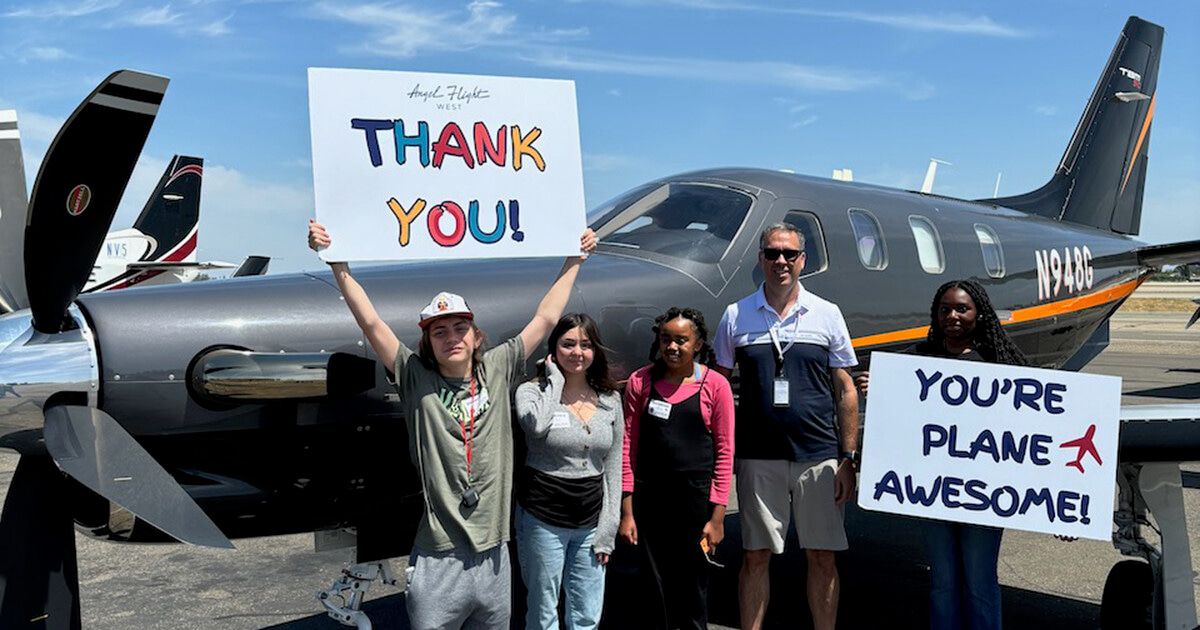
For Angel Flight West (AFW) volunteer pilots, summer camp missions offer a different sort of operation from the usual medical flights. On camp day, airplanes line up outside the FBO while a swarm of youngsters hauls sleeping bags, pillows, and duffels toward the aircraft that will carry them to camp or home again.
“You see kids moving from the FBO to the different airplanes, and there’s 20, 25 kids on the ramp, all dragging their gear along in various states of chaos, but they’re all there for the same reason,” volunteer pilot Eric Chadwick said in an interview with AIN.
On one return trip, Chadwick watched a camper roll “the largest suitcase I’ve ever seen” across the floor. She wasn’t his passenger, but he thought about whoever was flying her. “That pilot is not going to be happy about that,” he recalled thinking, with a chuckle.
According to AFW, its volunteer pilots fly hundreds of flights each year carrying children with life-threatening or life-altering medical conditions to specialized recreational camps across the western U.S. Most AFW flying is a solitary exercise, getting perhaps one patient to medical care. Camp missions are different, both for the kids aboard and for the pilots who fly them.
“A lot of Angel Flight West is so individual,” Chadwick said. “We pick up a mission, we pick up a passenger, we fly it. We don’t ever see other pilots.” Camp flights, by contrast, arrive at and depart from the same location in a concentrated period. “You really get to see the broader impact of the Angel Flight organization and how many people they’re moving at once.”
Unlike AFW’s medical-transport missions, camp flights don’t take passengers to treatment. Chadwick described them as a chance for kids to spend time with others who face similar hardships, whether at burn camps, deaf camps, or camps for children with serious illnesses.
“It’s one thing to have your physical needs cared for in the hospital, but it’s another to care for your soul and mental health journey after something as life-changing as a burn injury,” said Erika Mendoza, camps and recreation manager at the Alisa Ann Ruch Burn Foundation in Fresno, California. AFW has flown young burn survivors to the foundation’s Champ Camp for more than 30 years.
At burn camps, Chadwick said, “Sometimes you see the kids, and you can’t even tell what their injuries are, and then other times it’s very obvious: hands, face.” He marvels at the perseverance it takes campers to put themselves out in the world. Flying them is the easy part, Chadwick said.
“You generally hear a lot less complaining out of kids than you do adults when you get into medical situations like that,” he added.
One of those campers is Susy, now 16, who has traveled to Champ Camp since 2019, according to AFW. “As a burn survivor, Susy has walked a path that requires courage every single day,” said her mother, Viviana. “The trips didn’t just take her to camp; they lifted her confidence, her independence, and her sense of possibility.”
For pilots, camp passengers bring planning puzzles. “There’s always surprises when you pick up an Angel Flight passenger, especially from camp,” Chadwick said. Most of the gear is soft and stows easily, and in his six-seat turboprop, total weight is rarely the constraint. “For me, it’s more fore and aft,” he said. “If you stuff it all in the back, all of a sudden you’re pretty heavy on the aft end.”
Because camp legs tend to be shorter than other AFW missions, he has flexibility. “Fuel is usually your relief valve. So I rarely add fuel until I know what I’m getting.”
Outbound and return legs typically fall three days to a week apart. Chadwick works full time and flies mostly on weekends, so return legs, which often fall on Sundays, suit his schedule. With few pilots flying both legs, “it really does take a lot of coordination and a lot of different pilots volunteering their time,” he said.
Chadwick learned about AFW early in his pilot training and quickly concluded that flights with no particular destination, the proverbial $100-hamburger runs, should become “missions that you can do some good.” He tries not to let his airplane sit more than two weeks and aims for 20 to 25 missions a year. His wife often rides along when weight and balance allow, serving as an extra set of hands. “Somebody needs to be monitoring what’s going on,” he said. “It’s also been a nice thing for the two of us to do together.”
Andy Coy of San Diego began pursuing his pilot certificate in 2020. He has since logged 1,100 flight hours and 38 AFW flights, including Susy’s most recent trip home. “Camp flights are especially important to me,” Coy said. “Those kids have been through tough experiences, and I love seeing the camaraderie between the campers and counselors—laughing together, supporting one another, and being part of the group.”
Once airborne, campers are typical kids. Chadwick has packed five—ranging from grade schoolers to 18-year-olds—into his airplane for a flight between Fresno and Las Vegas. “Some of them can’t stop looking out the window, amazed at what you’re doing, and others are sleeping by the time you’re in the air,” he said.
One camper who rode up front was fascinated by everything, so Chadwick explained things throughout the flight, air traffic control calls included. Another, an older teen, “sat in the front right seat and slept the entire way.” Pointing to programs such as EAA’s Young Eagles, he encourages pilots to offer that seat when conditions permit, as a way to introduce a new generation to aviation. “If you’ve got a beautiful day to fly and they’re old enough to sit up there, I would always encourage that if you can.”
After all, flying them is the easy part.
More In Operations