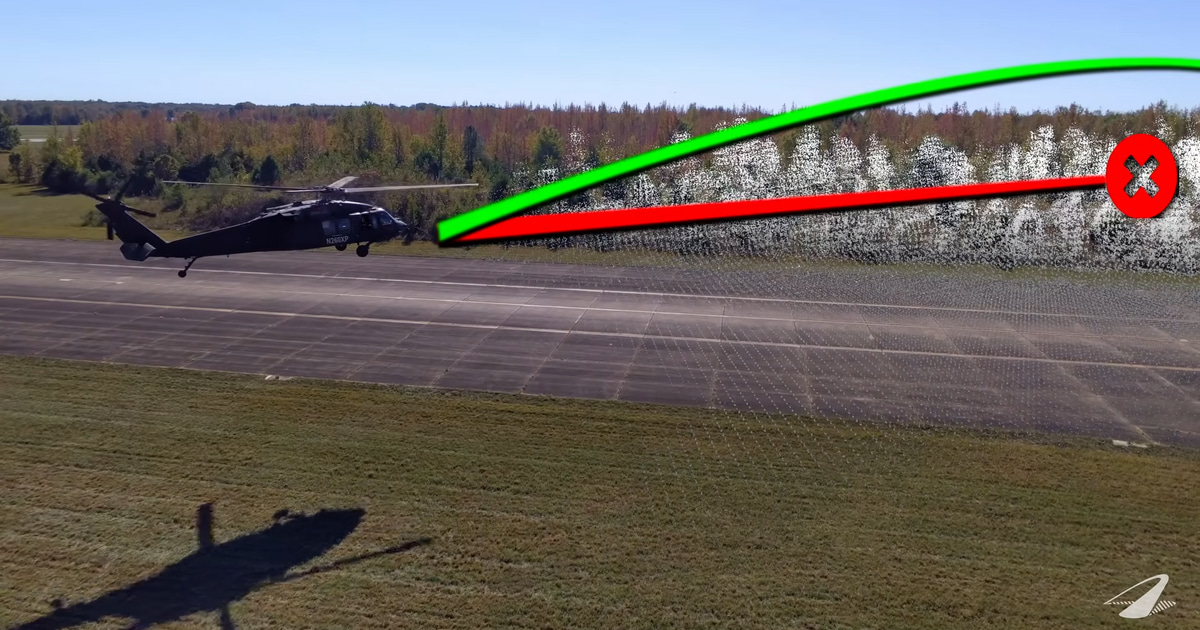
Near Earth Autonomy’s RUC-60, a Black Hawk helicopter modified to fly with or without a pilot, autonomously steered around obstacles during a November 19 exercise in Tennessee. The Pittsburgh-based company announced the exercise on November 23, reporting that the helicopter followed the terrain at 300 feet above the ground and carried out commands that remote operators sent midflight.
Working from ground control stations, operators planned and launched each mission, then monitored the helicopter as it flew beyond visual line of sight. They also ordered it to hold position when it was more than 45 nm away. The RUC-60, flying from Tullahoma Regional Airport/William Northern Field (KTHA), took off and landed on its own and assessed unprepared landing sites for slopes and other hazards. For the exercise, Near Earth integrated a long-range lidar sensor that let the helicopter spot obstacles from farther away and change course to avoid them.
Two safety pilots were on board to monitor the flights, but the autonomy system did the flying. They also kept in touch with air traffic control. “The pilots did not need to intervene at all during this long demonstration involving several flights,” Near Earth chief strategy officer Samuel Dinnar told AIN. He said the company expects to fly the RUC-60 with no pilot on board in late 2027 or 2028.
“Our goal is to deliver critical supplies without putting aircrews in harm’s way,” Near Earth CEO Sanjiv Singh said in a statement. “With the Army and our partners, we’re bringing together the capabilities needed for a utility helicopter to autonomously complete demanding logistics missions.”
Near Earth ran the November 19 event independently of the Army, Dinnar said, though it built on earlier Army flight tests. In July 2025, one of the company’s own Black Hawks made a fully automated flight from takeoff to landing for Defense Department officials at partner XP Services’ facility in Tullahoma. Earlier this year, the RUC-60 flew cross-country missions autonomously and landed at unprepared sites. Near Earth says it has completed 11,000 autonomous flights totaling 3,000 hours and integrated its systems into 60 aircraft types.
Autonomy Kits for Retiring Black Hawks
The Army’s Program Executive Office for Aviation awarded Near Earth a $15 million contract in April 2025 to develop kits that turn older UH-60L Black Hawks into optionally piloted helicopters. Near Earth says the kits will let them resupply troops in high-threat areas where GPS and communications may be unavailable. In a March statement, Singh said more than 700 Army UH-60Ls are headed for retirement in the next few years and that “each one can move up to 90,000 pounds of cargo a day.” The company wants the RUC-60 to carry up to 8,000 pounds per trip.
Under that contract, Near Earth has completed three demonstrations, the third of them recently, Dinnar said. Near Earth and the Army are also refining the prototype’s configuration, working with soldiers in exercises to develop tactics and procedures for an optionally piloted RUC-60, and continuing efforts to qualify it as airworthy.
Near Earth’s Captain autonomous pilot system is designed to fly with no crew on board or remote pilot at the controls, even if communications drop out. “Autonomy isn’t just about flight control; it has to take on the full role of the crew, including responsibilities we often take for granted,” chief technology officer Lyle Chamberlain said in the same statement.
Honeywell supplies avionics, navigation, and satellite communications for the RUC-60, while Moog provides its Genesys GRC 4000 autopilot and Tullahoma-based XP Services handles aircraft modification and flight testing. In August, Moog and Near Earth also announced a memorandum of understanding to offer Captain on other aircraft equipped with Moog’s Genesys avionics.
Near Earth is also prototyping an uncrewed Bell 505 light helicopter with Captain for U.S. Marine Corps cargo missions, working with Bell, Moog, and XP Services under an agreement that Naval Air Systems Command awarded in April.
Last year, Near Earth and Honeywell flew an autonomous Leonardo AW139 for another Marine Corps logistics program, and in March, Near Earth won a U.S. Navy contract for maritime drone operations. In July, UK-based Vertical Aerospace announced a memorandum of understanding to add Near Earth’s autonomy to its Valo eVTOL air taxi, starting with defense missions.
Near Earth plans more RUC-60 flight events in 2027, some with the U.S. Army and some with other partners, Dinnar said. The company will also build a more advanced prototype that year and test it before removing the pilot. Last year, the company said it planned to fly with a safety pilot on board in 2026 and with no pilot on board in 2027, and to produce systems for Army units in the field in 2029.
Sikorsky, which builds the Black Hawk, has already flown its UH-60A Optionally Piloted Vehicle demonstrator with no one on board, first over Fort Campbell, Kentucky, in February 2022, using its Matrix autonomy system in a Defense Advanced Research Projects Agency program. That October, an uncrewed Sikorsky Black Hawk flew cargo resupply and simulated casualty evacuation missions during an Army experiment in Arizona.
In March, Sikorsky delivered an optionally piloted UH-60MX rotorcraft to the Army for evaluation at Fort Eustis, Virginia. That helicopter pairs Matrix with full-authority fly-by-wire controls that Sikorsky and Army engineers installed in 2025. On the RUC-60, Captain flies through Moog’s GRC 4000 autopilot, which uses parallel actuators to move the Black Hawk’s existing flight controls much as a pilot would.
More In Unmanned Aerial Vehicles