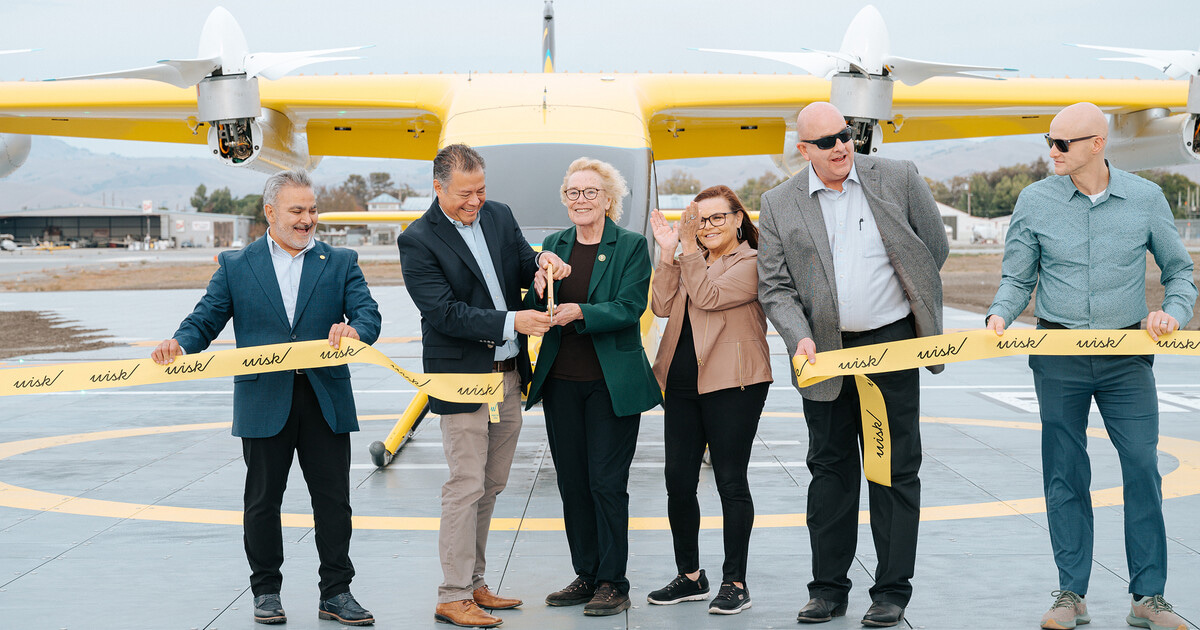
Wisk Aero has opened a 100-by-100-foot vertiport at Hollister Municipal Airport (KCVH) in California to test landing and navigation systems for autonomous aircraft, using surrogate helicopters and its pilotless Gen 6 eVTOL air taxi, the company announced on October 30. Construction began in August, and Wisk held a ribbon-cutting ceremony at the site on October 29. The company calls it one of the first U.S. vertiports at a public airport built for both piloted and autonomous aircraft.
According to a July filing by the city of Hollister, a Bell 206 with sensor packages and a pilot on board will first demonstrate basic landings and takeoffs through early 2027. Later phases, running from late 2026 through early 2028, call for Gen 6 aircraft to begin using the pad for autonomous hover tests followed by more advanced maneuvers. Wisk calls the vertiport “fully operational” but has not said whether any aircraft has used the pad yet.
While the city’s filing calls the pad a “temporary” vertiport structure, Wisk describes it as a “deployable facility [that] can be easily adapted to future flight-testing sites.” The elevated steel platform has solar panels and power banks, plus connectors to the airport’s taxiways. Wisk said its own transceivers, mounted on the pad, will let it test precision navigation in low or zero visibility. It also plans to fly landings, missed approaches, and pinpoint touchdowns without GPS.
Wisk also calls the vertiport an “infrastructure anchor” for the California Advanced Air Mobility Corridors Initiative, a Monterey Bay Economic Partnership effort to establish a flight corridor connecting public airports along California’s Central Coast.
“Deploying our aircraft on a purpose-built vertiport gives us the exact physical setup needed to validate precision landing technologies and our complete autonomy stack,” said Wisk CEO Sebastien Vigneron.
Vigneron added that Wisk will feed data from the vertiport’s operations into the FAA’s eVTOL Integration Pilot Program (eIPP). Mountain View, California-based Wisk is a partner on the Texas Department of Transportation’s eIPP project, as is Archer Aviation, which expects to close its acquisition of Wisk from Boeing by year-end.
Wisk said it built the vertiport to existing FAA standards. On October 22, the FAA released a draft advisory circular that would replace its interim vertiport guidance. Public comments are due Jan. 11, 2027, and the FAA expects to issue final standards in summer 2027. The draft says guidance for facilities serving aircraft with no pilot on board will follow further FAA research and tells airport operators expecting such aircraft to coordinate with FAA district offices.
In this article
More In Airports