Born as a small gathering among the Learjet flight demonstration teams in 1996, the Bombardier Safety Standdown will mark its 30th anniversary this year with more than 400 anticipated in attendance and thousands more online. Scheduled from November 9 to 12 in Wichita, the four-day event is themed “Evolution Fueled by Legacy” in recognition of not only the history and foundations of Safety Standdown, but also how safety and the culture surrounding it have progressed through the years.
“It is a milestone event,” said Chris Milligan, v-p of preowned aircraft services, who takes the lead on Safety Standdown. “It started the same year that I came in [to Bombardier]. I just happen to be fortunate to be in the position that I am right now. The journey that this event’s had with Bombardier is incredible.”
Safety Standdown began in Wichita as an aviation safety training event that brought together Bombardier’s Learjet demo teams both locally and in Hartford, Connecticut. The event was so positively received that it continued, and by 1999, it had opened to others in the industry and morphed into what it is today. With safety, Milligan said, “We don’t see competition. It’s an industry event.”
Held for free nearly every year at the Wichita Hyatt Regency, the event soon reached a capacity of just over 400. So, in 2010, Bombardier began streaming the program and extended it to thousands around the world. Bombardier has also expanded its content beyond that presented during Safety Standdown, posting different material periodically “to try to make it a year-round event.” This provides access to organizations even when they don’t attend Safety Standdown in person.
Over the years, Safety Standdown has become one of the hallmark safety events in business aviation, attracting a range of attendees. Initially geared toward pilots, the event now draws attendees from management, maintenance, and even human resources. Officials from NBAA, the Air Charter Safety Foundation, Citation Jet Pilots Association, and many others regularly attend. But it has gone beyond the industry, garnering interest from the automotive community, among others.
Milligan said this growth “really speaks to the fundamentals of our advisory board.” Bombardier has assembled an advisory board that represents a cross-section of industry and safety experts. That board begins planning the next event the day Bombardier finishes the current event, he noted. “They are the ones that come up with all the great topics,” he said. Not only do they understand the emerging safety issues, “they know the speakers that are in the industry that are up and coming.”
By having a cross-section of leaders, they can bring ideas to the table for pilots, maintenance personnel, directors of aviation, and, more recently, recruiting. Human resources was an important addition because people in this discipline could explore “how do we create the culture; how do we create [safety] from your hiring,” Milligan explained. “It is end to end. It’s organizational. It’s not just pilots or directors of aviation; it’s manufacturing of the airplane, how you service the airplane, and everything from A to Z. Over the years, it’s become more inclusive, and that I think is one of its strengths. There are no borders to who can be involved and who’s responsible for safety.”
Important to Bombardier is that attendees bring back the lessons shared and encourage other colleagues to attend. In fact, about 45% of attendees in a given year are there for the first time. Milligan said he’s been told: “I got so much out of it, I want to send somebody new. I really want to include my organization.”
And on the workforce development front, a few years ago Bombardier formed a sponsorship fund to bring in three people, whether students or those new to the industry, to attend Safety Standdown. The fund will contribute toward their travel expenses so they can attend. Those interested can apply and submit an essay for evaluation. Once at the event, leaders, including the members of the advisory board, will sit with them during lunchtime to share their experiences both in safety and in the industry. “The amount of questions they ask is incredible,” Milligan noted.
Speakers over the years have ranged from National Transportation Safety Board members and association leaders to experts in medical fields and safety science, sleep researchers, and those involved in operations—from single-pilot to large fleets. They have appeared to share personal stories of tragedies, probe key accidents, inform, and challenge the audience.
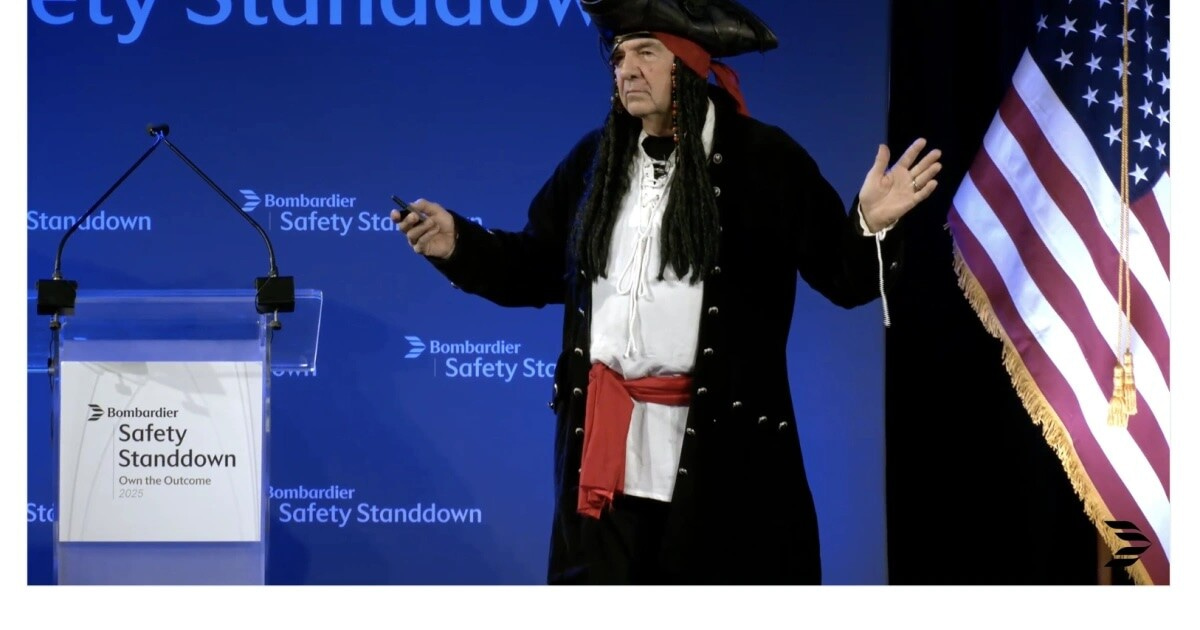
A perennial favorite returning this year is Tony Kern, director of aviation for Alaskan operations for Hilcorp, former CEO of safety organization Convergent Performance, podcaster, author, and widely renowned as one of the preeminent aviation safety experts. Kern often kicks off Safety Standdown dressed in a costume reflecting the topic du jour. Last year’s costume was a pirate for his talk: “Under the Black Flag: Lessons on Performance and Culture from Men Without a Country.” This year’s discussion, “John Boyd, Chaos Theory, Artificial Intelligence, and Polar Bears: The Sublime Art of Living in the Yellow,” leaves open all sorts of possibilities.
Also on tap this year during the general sessions is Ivan Pupulidy of the University of Alabama at Birmingham and author of Human & Organization Potential, speaking on “Risk: The Untold Story.” Jermaine Cadogan, a retired U.S. Marine major, is presenting “Building a Culture of Excellence & Proactive Compliance.” Tim Wade, corporate director of environmental, health, and safety for Flexjet, is discussing “What You Lead, You Leave.” Attendees will also hear discussions on safety under pressure, crew resource management, workforce challenges, emotional intelligence, medical updates, and compliance.
Other luminaries will lead the workshops on a host of topics in the afternoon. Attendees will be able to pick a couple each day from as many as 11 offerings.
While not a scheduled speaker in the general session this year, Amy Grubb—who specializes in change management and is serving as a digital transformation advisor for the FBI—has made frequent appearances before attendees and chairs the Safety Standdown advisory board.
Opening the event on November 9 with a reception, Bombardier will also host a dinner banquet where it presents a safety award.
From the outset, Safety Standdown was held with the objective “to improve aviation safety standards and sustain positive changes within the industry.” While that objective hasn’t changed, the scope of the event has broadened. In planning the 30th edition, Milligan said, “We were talking about how safety has evolved as a topic. How comprehensive it is now versus 10, 15, or 20 years ago.”
Milligan said the approach has changed from “tasks that we do each day to be safer to a culture that we create for our organization. It starts at the top from the standpoint of the culture you try to create and everything that you do.” This culture aims to provide transparency and openness toward disclosure so an organization can be more proactive.
The discussion on this year’s event led to the fact that “we all have an opportunity to leave a legacy,” he continued.
While Safety Standdown is held almost every year in Wichita, Bombardier did experiment with another location in Fort Worth, Texas, to provide more space. But it returned to Wichita. “With Wichita being the aviation capital of the U.S., it’s our home for defense, our service center, and our flight test organization; it really is the nucleus for us,” he said. That doesn’t mean at some point in the future the company won’t explore another location. But for the time being, it will be in Wichita.
Safety Standdown also has resulted in a spinoff of sorts: Bombardier’s Flight Attendant Safety Summit. Held annually in Montreal in August, that event has spread to summits in Europe and Asia. Milligan noted that Bombardier continues to discuss international Safety Standdowns as well—especially given attendees who tune in around the world—but sees it initially being folded into its various maintenance and operator meetings. But nothing on that front is concrete just yet.
He noted that many people have played an important role in how the event has evolved from the first group of pilots to the many supporters over the years. “We want to really pay tribute to those that have supported the evolution and the legacy of it.”
At the same time, Bombardier discussed how the event can continue to evolve “and continue to fuel the evolution that we’ve seen over the last 30 years,” he said.
In this article
More In Safety