The path Future Flight Global (FFG) is taking to offer point-to-point air transportation in Florida is set to start with Pilatus PC-12s, turboprop singles that have been in production since the mid-1990s, before transitioning to electric aircraft. Having launched its per-seat scheduled flight business model last week, the self-styled “mobility management company” said it is close to signing contracts with one or more air charter operators to launch services under U.S. DOT Part 380 rules in the first quarter.
FFG co-founders Karan Singh and Toni Drummond, who have long been active in the business aviation sector, believe they will be able to offer regional air service that bypasses airline terminals at rates comparable to premium car rideshares. “We are trying to open up the market because even for passengers who fly first class [with airlines] the jump [in price] to private charter flights is huge,” Singh told AIN. “The entry point [for a private aviation flight] is around $10,000 and we do it for a few hundred dollars per seat.”
Following in the footsteps of service providers such as JSX and Blade, FFG intends to leverage its alliance with FBO group Signature Aviation and vertiport developer Urban V. The PC-12 flights will operate from private terminals with eight seats for sale via its booking site or other platforms for scheduled departures.
According to Singh, access to business aircraft can seem complex with prospective clients sometimes feeling they are “flying blindly” in a web of brokers and other service providers. “We need a new approach where we sit on the passenger’s side of the table,” he explained. “[Unlike charter brokers], we don’t get paid based on how much they spend, and we are not trying to make things opaque.”
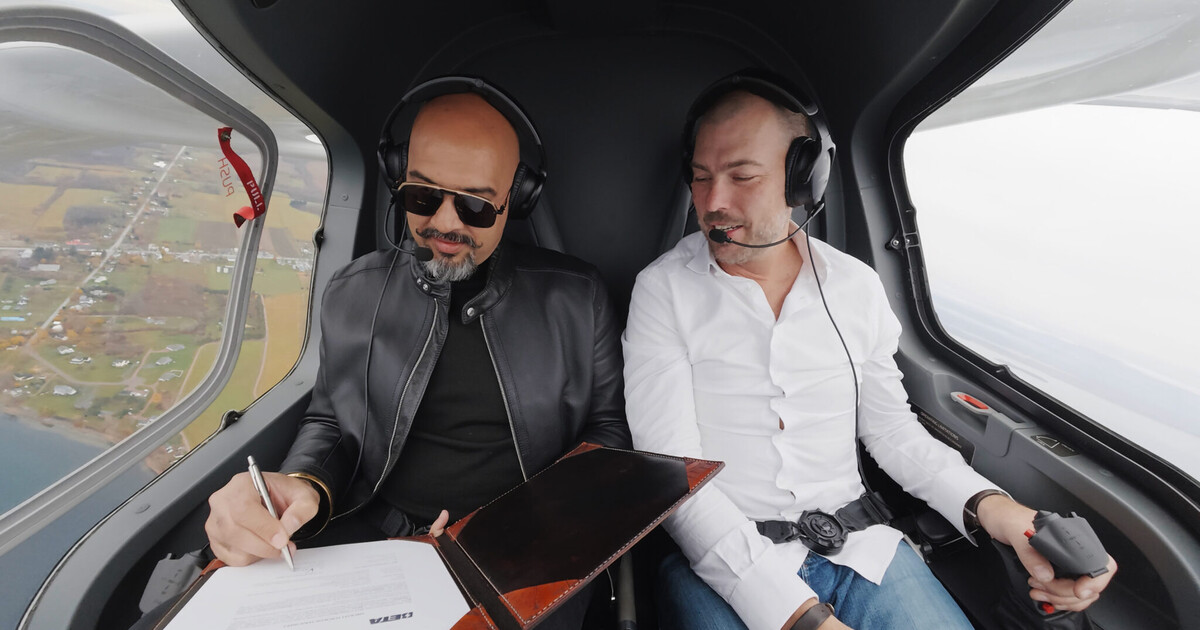
On November 5, FFG committed to make Beta Technologies’ Alia CX300 electric airplane the next step in its service offering. A contract signed by Singh and Beta founder Kyle Clark while flying the five-passenger model over Florida covers firm orders for 10 and options for another 10.
These aircraft, which will operate in fixed-wing mode from runways, will be directly operated by FFG, which is in the process of securing its own Part 135 air operator certificate, most likely through an acquisition. The company, which Singh described as “aircraft agnostic,” also has deposit-backed purchase agreements with eVTOL developers Archer and Eve.
FFG is also evaluating Electra’s EL9 blown-wing aircraft, which is intended to be deployed on “direct aviation” routes that could operate from surfaces as short as 150 feet. “We could look at others, too,” Singh acknowledged, adding that it has chosen to start with the PC-12 because it is “a proven workhorse with the right field performance, reliability, and seat-mile costs.”
The company, which is backed by several investors and is preparing to launch a fresh funding round next year, may opt for sale-and-leaseback arrangements for part of its fleet. “Having the aircraft under our control is what matters,” Singh said. “This will be an asset-light operation, and we have term sheet offers from leasing companies on good terms because they have confidence in electric aviation that will retain the value well with lower maintenance and energy costs.”
Singh, a former Boeing 737 airline pilot with 5,000 flight hours, envisions eVTOL vehicles providing last-mile connections for FFG’s customers by operating in tandem with airplanes. FFG has opted not to use helicopters because it said operating costs are too high to expand the market for point-to-point urban flights.
“There is a lot of skepticism around the certification [timeline] for eVTOLs, but this technology is truly transformative,” Singh commented. “Look at what has happened with electric cars [in terms of market growth]. Electric motors are much simpler [than current aircraft engines] with one moving part, no controlled explosion, and it could take just $15 of electricity to make these flights.”
The other key partner in FFG’s operation is Florida-based S3Nova Partners, which describes itself as “an institutional commercialization and execution platform advancing next-generation mobility.” In addition to paving the way for service launch with local stakeholders, it will support business-to-business transactions that could include companies buying batches of seats to move employees around the state more conveniently—a type of contracted corporate shuttle service.
FFG said it has conducted extensive route models, demand studies, and operational costings using proprietary tools and demographic data. It has also established demand for direct flights between Florida cities such as Ocala, Kissimmee, Boca Raton, Tampa, Miami, and state capital Tallahassee. The next step is finalizing schedules for departures at specific times on specific days.
“Florida is a huge state and even relatively short journeys can now take as much as two and a half hours in heavy traffic,” Singh stated. “We can do these in around 30 to 50 minutes, and avoid inefficient airline routes, such as flying via Atlanta.”
Singh believes this approach could restore networks of regional airline networks that have been in decline since the early 1990s as major carriers consolidated hub-and-spoke services. In the longer term, FFG aspires to replicate the new model in other locations.
In March 2025, the FAA selected the company as an operator partner for its eVTOL Integration Pilot Program for an exercise spanning Utah, Oklahoma, and parts of the Pacific Northwest and Rocky Mountains.
More In Charter & Fractional